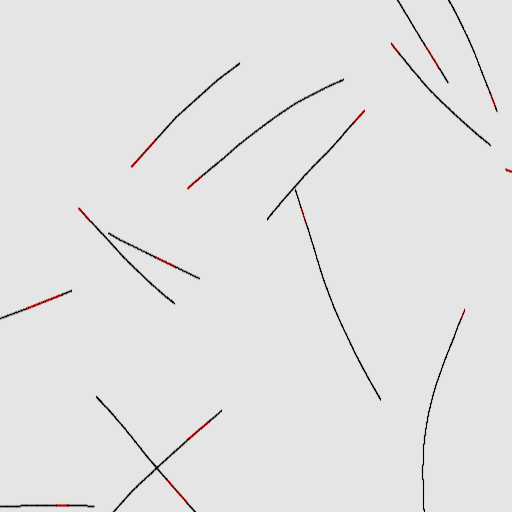
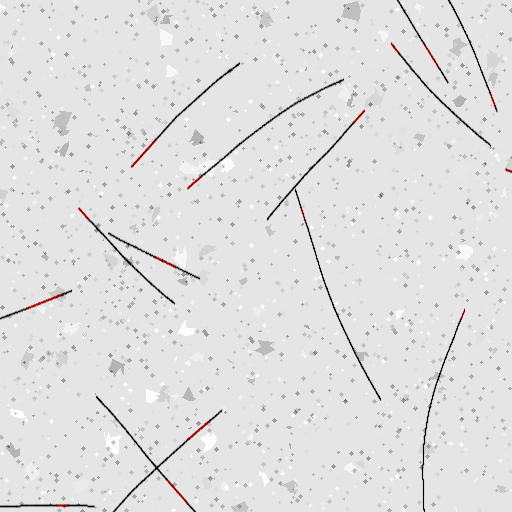
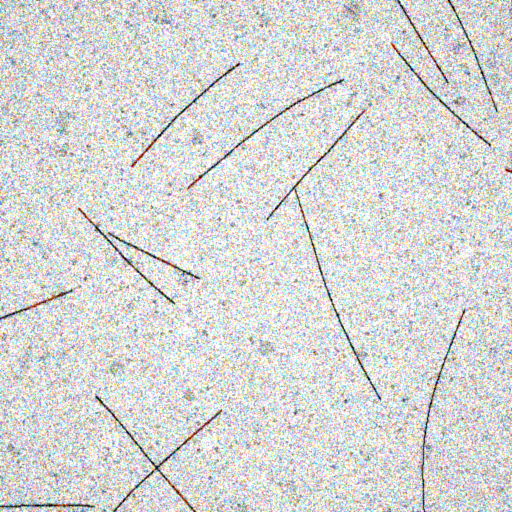
We introduce the SynthMT dataset to study the readiness of automated microtubule analysis with state-of-the-art foundation models.
Studying microtubules (MTs) and their mechanical properties is central to understanding intracellular
transport, cell division, and drug action. While important, experts still need to spend many hours
manually segmenting these filamentous structures. The suitability of state-of-the-art methods for this
task cannot be systematically assessed, as large-scale labeled datasets are missing. We address this
gap by introducing the synthetic dataset SynthMT, produced by tuning a novel image
generation pipeline on real-world interference reflection microscopy (IRM) frames of in vitro
reconstituted MTs without requiring human annotations. In our benchmark, we evaluate nine fully
automated methods for MT analysis in both zero- and Hyperparameter Optimization (HPO)-based few-shot
settings. Across both settings, classical algorithms and current foundation models still struggle to
achieve the accuracy required for biological downstream analysis on in vitro MT IRM images that
humans perceive as visually simple. However, a notable exception is the recently introduced
SAM3 model. After HPO on only ten random SynthMT images, its text-prompted
version SAM3Text achieves near-perfect and in some cases super-human performance on unseen,
real data. This indicates that fully automated MT segmentation has become feasible when method
configuration is effectively guided by synthetic data.
SynthMT): We release SynthMT,
a synthetic dataset with instance masks for MTs, judged by domain experts for
biological plausibility.SynthMT β zero-shot and with HPO β so you know what actually works.
SAM3Text + simple HPO on just 10 synthetic
images from our pipeline β human-grade segmentation on real data. Fully
automated MT analysis is here! βSKIoU (Skeleton IoU) measures how well predicted segmentations match ground-truth microtubule shapes β the core metric for filament segmentation.
Count measures the absolute difference in the number of detected filaments compared to the ground truth.
Length KL and Curvature KL capture how well the model preserves biologically meaningful properties. Lower = predictions match ground-truth MT distributions better.
FIESTA baseline, and microscopy-specific models often outperform
general ones on biological tasks.SAM3Text.
SAM3Text enables automation: With HPO, it achieves human-grade
performance on real data, proving that fully automated MT analysis is feasible.π‘ Full results with all models and metrics available in the paper.
SynthMT| Model | SKIoU β | Length KL β |
Curvature KL β |
|---|---|---|---|
| Traditional Baselines | |||
FIESTA |
0.12 | 5.03 | 0.997 |
FIESTA + HPO |
0.24 | 3.74 | 0.706 |
| Pretrained Domain-Specific Models | |||
TARDIS |
0.45 | 0.56 | 0.019 |
TARDIS + HPO |
0.48 | 0.41 | 0.031 |
| SAM-based Models | |||
Β΅SAM |
0.02 | 0.88 | 0.130 |
Β΅SAM + HPO |
0.66 | 1.24 | 0.132 |
CellSAM |
0.56 | 0.19 | 0.021 |
CellSAM + HPO |
0.59 | 0.21 | 0.031 |
Cellpose-SAM |
0.27 | 0.12 | 0.019 |
Cellpose-SAM + HPO |
0.65 | 0.12 | 0.012 |
| Foundation Models | |||
SAM |
0.37 | 3.90 | 0.700 |
SAM + HPO |
0.16 | 5.45 | 0.912 |
SAM3Text |
0.85 | 0.07 | 0.063 |
SAM3Text + HPO π |
0.93 | 0.02 | 0.069 |
| Model | Count (n/img) | Length KL β |
Curvature KL β |
|---|---|---|---|
| SAM-based Models | |||
CellSAM |
21.29 | 0.07 | 0.09 |
CellSAM + HPO |
16.73 | 0.08 | 0.14 |
Cellpose-SAM |
12.27 | 0.05 | 0.18 |
Cellpose-SAM + HPO |
13.00 | 0.07 | 0.09 |
| Foundation Models | |||
SAM |
28.55 | 0.79 | 0.16 |
SAM + HPO |
108.26 | 1.39 | 0.15 |
SAM3Text |
14.98 | 0.21 | 0.25 |
SAM3Text + HPO |
25.08 | 0.09 | 0.14 |
| Inter-annotator | 25.29 | 0.09 | 0.11 |
| Ground Truth | 23.91 | 0 | 0 |
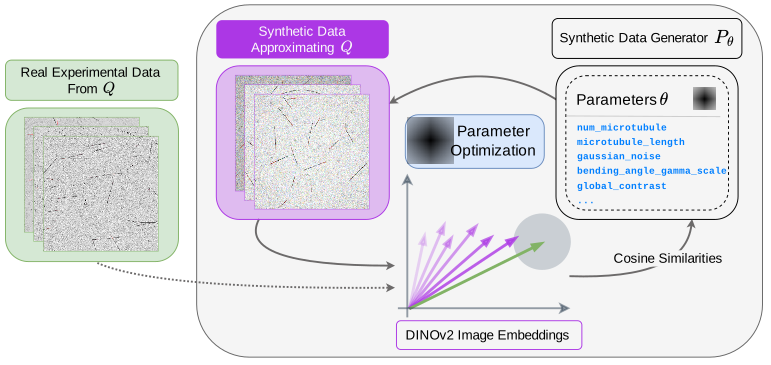
To photorealistic microscopy images in 5 steps.

Generate MT masks with realistic geometry.
Apply optical system simulation.
Add realistic imaging artifacts.
Inject sensor and shot noise.
Apply intensity and contrast variations.
Optimizing θ aligns synthetic image distributions with real microscopy data without the need for annotations.
@article{koddenbrock2026synthetic,
doi = {10.1371/journal.pcbi.1013901},
author = {Koddenbrock, Mario AND Westerhoff, Justus AND Fachet, Dominik AND Reber, Simone AND Gers, Felix A. AND Rodner, Erik},
journal = {PLOS Computational Biology},
publisher = {Public Library of Science},
title = {Synthetic data enables human-grade microtubule analysis with foundation models for segmentation},
year = {2026},
month = {05},
volume = {22},
url = {https://doi.org/10.1371/journal.pcbi.1013901},
pages = {1-25},
number = {5}
}
Our work is funded by the Deutsche Forschungsgemeinschaft (DFG, German Research Foundation) Project-ID 528483508 - FIP 12. We would like to thank Dominik Fachet and Gil Henkin from the Reber lab for providing data, and also thank the further study participants Moritz Becker, Nathaniel Boateng, and Miguel Aguilar. The Reber lab thanks staff at the Advanced Medical Bioimaging Core Facility (CharitΓ©, Berlin) for imaging support and the Max Planck Society for funding. Furthermore, we thank Kristian Hildebrand and Chaitanya A. Athale (IISER Pune, India) and his lab for helpful discussions, and the authors of the SCAM project page for their template.